Historic Vehicle Tax and MoT - The 40-year rule
Looking for a classic-friendly MoT station?
Click here: https://www.fbhvc.co.uk/historic-friendly-mot-stations
Want to know about the updated DVLA classic car registration policy?
Click here: https://fbhvc.co.uk/dvla
Disclaimer: The information provided does not and is not intended to constitute formal legal or other specialist advice, but is intended to be guidance based on official sources and experience to set out the general principles. The Federation is not able to provide specific legal advice tailored to individual circumstances.
Historic Vehicle Tax and MoT - the '40-year rule'
Please see our guidance below - but note that once your vehicle passes '40 years old' you need to take specific actions to make changes for the vehicle tax (Vehicle Excise Duty - VED).
If you do nothing, you will continue to need to pay VED.
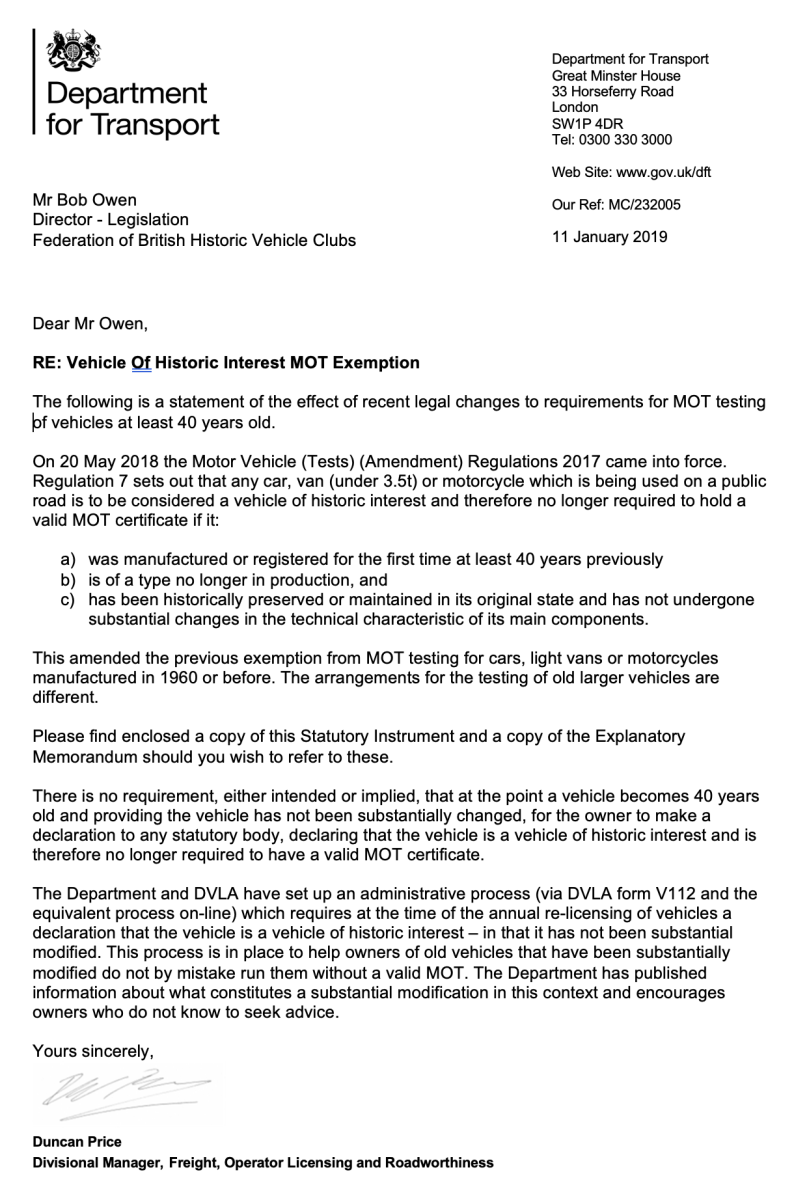
Also, note that there is not a direct connection between the criteria for registration in the ‘historic’ tax class and hence exemption from VED, and the criteria to be considered as a Vehicle of Historic Interest (VHI) and thus qualify for MoT exemption.
In fact, they are separate situations with no commonality other than '40 years' and even that is applied differently!
IMPORTANT WARNING: All vehicles in the Historic Tax class MUST be insured for use on the road at all times, unless they are on a SORN. If your insurance lapses, you will be committing an offence and be liable to an automatic fine and prosecution. To avoid this, if your vehicle is not insured, it must be declared with a SORN (Statutory Off Road Notice). https://sorn.service.gov.uk/. Declaring a vehicle that is in the Historic Vehicle tax class on SORN, will not change its status, or affect it when you come to put it back on the road (by taxing it at the £nil rate).
Click on a yellow box below to jump to a topic
Is my vehicle exempt from vehicle tax How to apply for tax exemption Is my vehicle MoT exempt How to get MoT exemption What is a 'substantial change' How do I know MoT exemption is active How to change the V5C date of manufacture List of Club specialists
Is my vehicle exempt from vehicle tax?
A vehicle which has attained 40 years age, whilst being test exempt, will need to continue to pay vehicle excise duty (VED) in the 'private light goods' or other relevant tax class until April of the following year.
You can tax your vehicle in the 'historic vehicle' tax class from 1 April if your vehicle is recorded on the V5C registration certificate (log book) as "first registered" more than 40 years ago (i.e. 1985) and is one of the qualifying vehicles listed in the DVLA leaflet INF34.
The same rules apply to vehicles (such as kit cars) that have a 'Q' plate.
If the vehicle was originally first registered overseas, your V5C will show a 'manufactured' date in the notes section on page one. If this is more than 40 years ago (i.e. 1985) will be accepted, even if the date of 'first registration' is later - as this relates to its date of registration in the UK.
The DVLA allows a few days grace at the year end, for "first registered" dates up to and including 7 January 1986, to qualify to be tax exempt.
Currently, a vehicle "first registered" on/prior to 7 January 1986, will be classed by the DVLA as having been built in 1985, therefore it is tax exempt from 1 April 2026.
If your vehicle was 'first registered' after this date, up to 31 December 1986, you will need to wait until 1 April 2027.
Younger vehicles become eligible in the April after the year in which they become 40 years old.
For example, a vehicle "first registered" in February 1986 will be eligible to tax as a historic vehicle from 1 April 2027.
DVLA leaflet INF34 gives further information, and official details are here: https://www.gov.uk/historic-vehicles
How do I apply for vehicle tax exemption?
Firstly, make sure you've read the section above to ensure that your vehicle (motorbike, car etc) is eligible.
Apply at a Post Office that deals with vehicle tax. You need to take:
- The log book (V5C) in your name
- Your vehicle tax reminder letter (V11), if you have one
- A MOT certificate that’s valid when the tax starts, or the completed declaration form if your vehicle is exempt from an MOT test using DVLA form V112 or V112G (goods)
- An insurance certificate or cover note (only required for vehicles in Northern Ireland).
On your V5C, in the 'Tax Class' box in section 1 'Change my vehicle details' write the words HISTORIC VEHICLE - see example below.
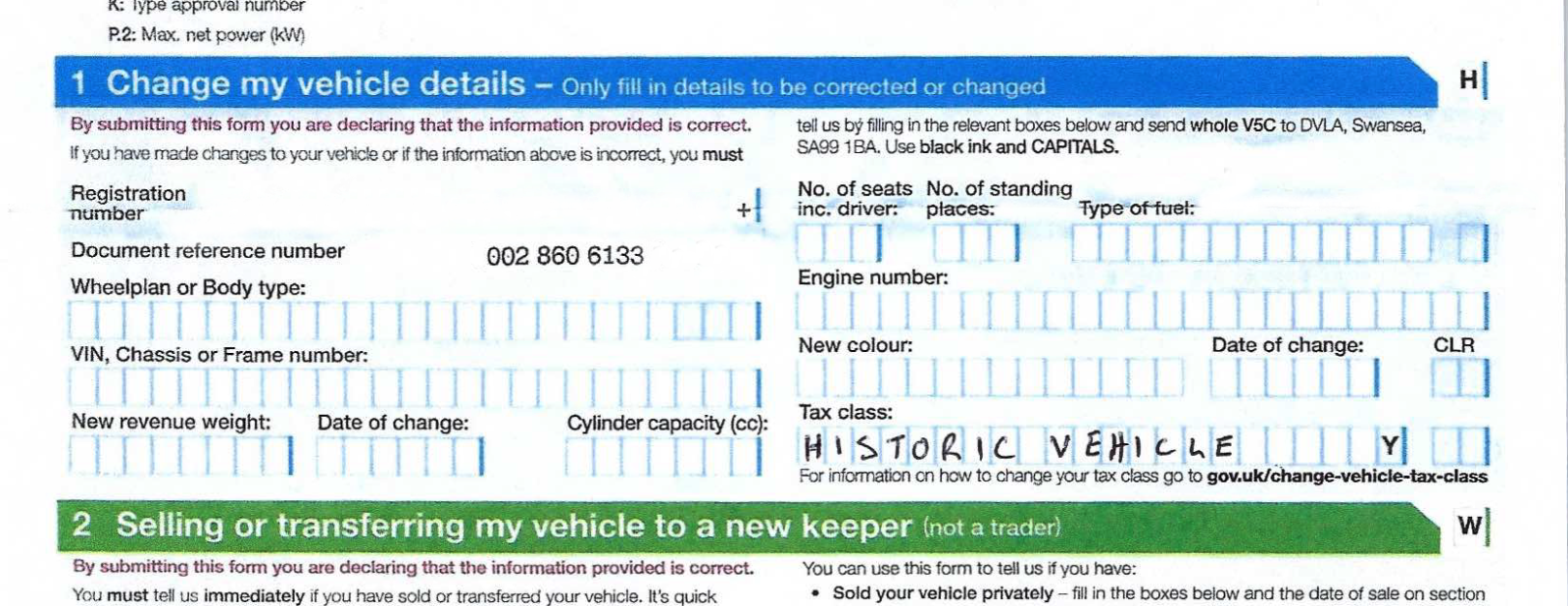
While most Post Office branches are familiar with the process, sometimes newer staff are not. If so, simply tell the counter clerk that you wish to change the tax class to 'Historic Vehicle'. They go into their system, select 'change tax class' and the system guides them through the process. They will keep the V5C (you will be sent a replacement showing the new tax class) and your V112 .
Certain vehicles (principally former commercial vehicles which are in obsolete tax classes) seem to present a problem for post offices. In the case of these vehicles it may be necessary to send the V5C together with forms V10 and V112/V112G or a MoT test certificate to the DVLA.
In subsequent years a vehicle which is already in the historic VED class can be taxed either online or at a post office. You must continue to tax the vehicle each year, but there is no fee.
What happens next?
- The Post Office sends your log book to DVLA.
- You’ll get a confirmation from DVLA within 10 working days that the change has been made.
- DLVA will send you an updated log book within 4 weeks. You can still use your vehicle while your application is being processed.
- You will get a refund (by cheque) of any remaining full months of unexpired tax on a pro rata basis.
Is my vehicle exempt from MOT?
Vehicles (except lorries) generally become eligible for MOT exemption from the date they become 40 years old ( *How do I know if this has been applied? See section below).
If your vehicle (car/motorcycle/bus) has not been substantially altered according to the Department for Transport Guidance it will be exempt from MOT https://www.gov.uk/historic-vehicles . However, it is your responsibility to ensure it is kept fully roadworthy.
Note, however, that a motorcycle issued with a registration number with a ‘Q’ prefix or assembled from components from different makes and model of vehicle will be considered as ‘substantially changed’ and thus not MoT exempt.
Unless they are substantially changed, large goods vehicles (lorries) are exempt from testing, if they:
- were first used before 1960
- are currently used unladen
A small number of pre-1960 large goods vehicles may require testing.
How do I exempt my vehicle from MOT? (cars/motorcycles/buses)
This is a self-declaration process to be carried out as part of annual licensing by DVLA by a keeper of a qualifying vehicle who does not wish to submit the vehicle to an MOT test.
By making this simple declaration you are confirming that your vehicle is at least 40 years old and has not been substantially changed.
If your previous MOT has expired, you only need to declare your vehicle as MOT exempt at the point of taxation in one of the following two ways:
- Visit your Post Office with a completed V112 or V112G (for goods vehicles) form
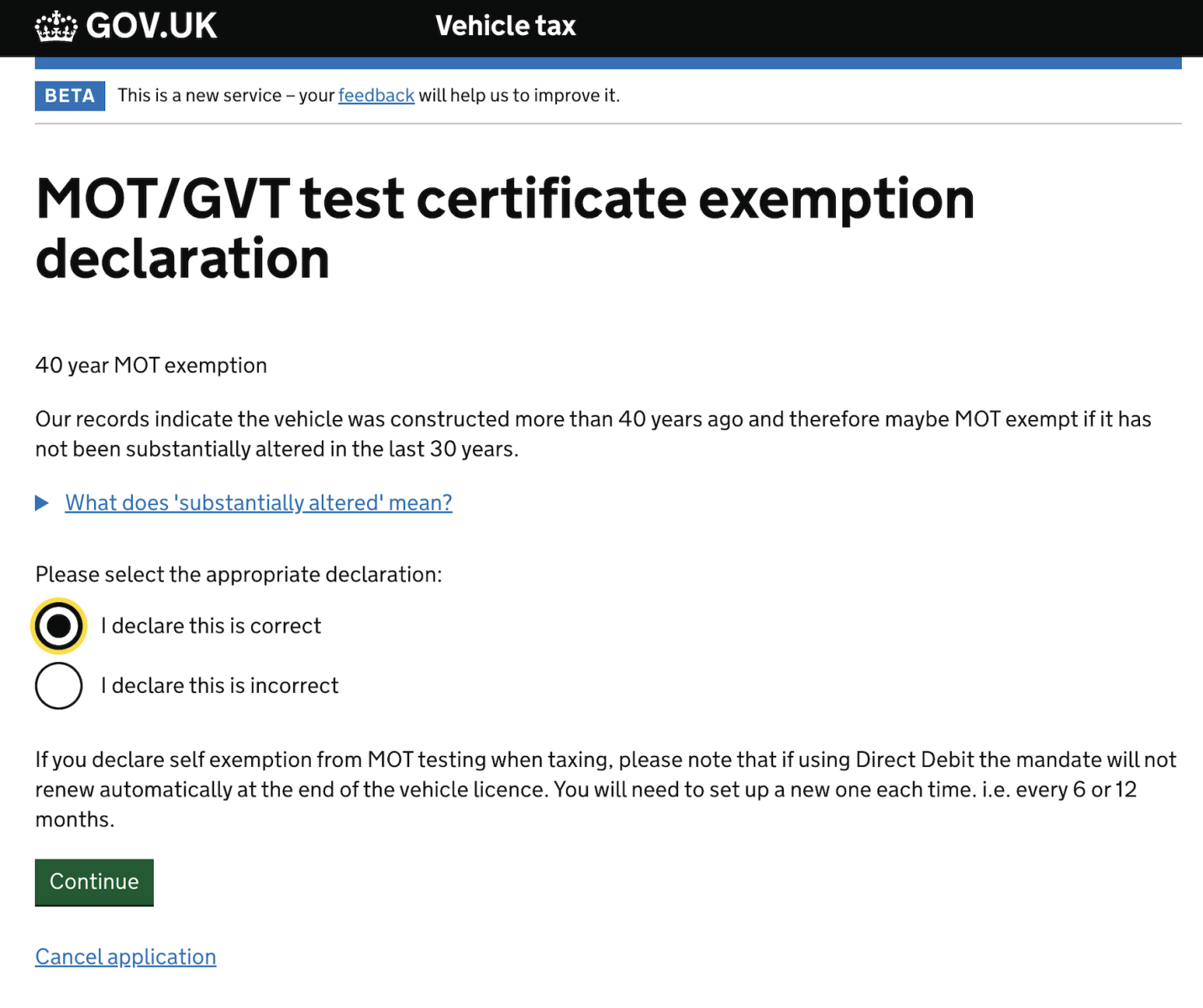
- Or tax your vehicle online. https://www.gov.uk/vehicle-tax
When taxing your vehicle online, all post-1960s vehicles will show an extra 'tick box' for you to complete to exempt your vehicle, whereas pre-1960s vehicles will not. A sample of the screen is below:
MOT test exemption - what is a 'substantial' change?
The Department for Transport (DfT) has published a set of guidelines to assist owners in deciding which if any more recent changes to their vehicle would be considered as “substantial”.
The DfT understands that owners may feel they need to consult a specialist prior to making this declaration and have asked the Federation of British Historic Vehicle Clubs to compile and publish on its website, a list of marque specialists who have indicated their willingness to advise owners unsure of their vehicle’s status.
The list is published below (download link at the foot of this page) and it is continuously added to, as more specialists come forward.
Before approaching a marque specialist you should study the DfT guidelines carefully and make your own judgement concerning your vehicle, if you can.
An expert or an organisation nominating an expert is entitled to reimbursement of any costs incurred in reaching or providing the opinion and may make a reasonable charge for the service provided, which may be different depending upon whether the keeper making the request is or is not a member.
It is your responsibility to accurately describe your vehicle as no inspection will be made. Their advice is provided solely in relation to the declaration you will make regarding a vehicle of historical interest (VHI).
If there is not a specialist listed here for your type of vehicle you may contact the FBHVC Secretary ([email protected]) who will advise you.
How do I know if the MoT exemption has been applied?
 'How do I know if the MoT exemption has been applied?' This is a common question. As stated above, everytime you tax the vehicle you will be required (either in person using form V112 or online) that you are declaring the self-exemption from MoT testing.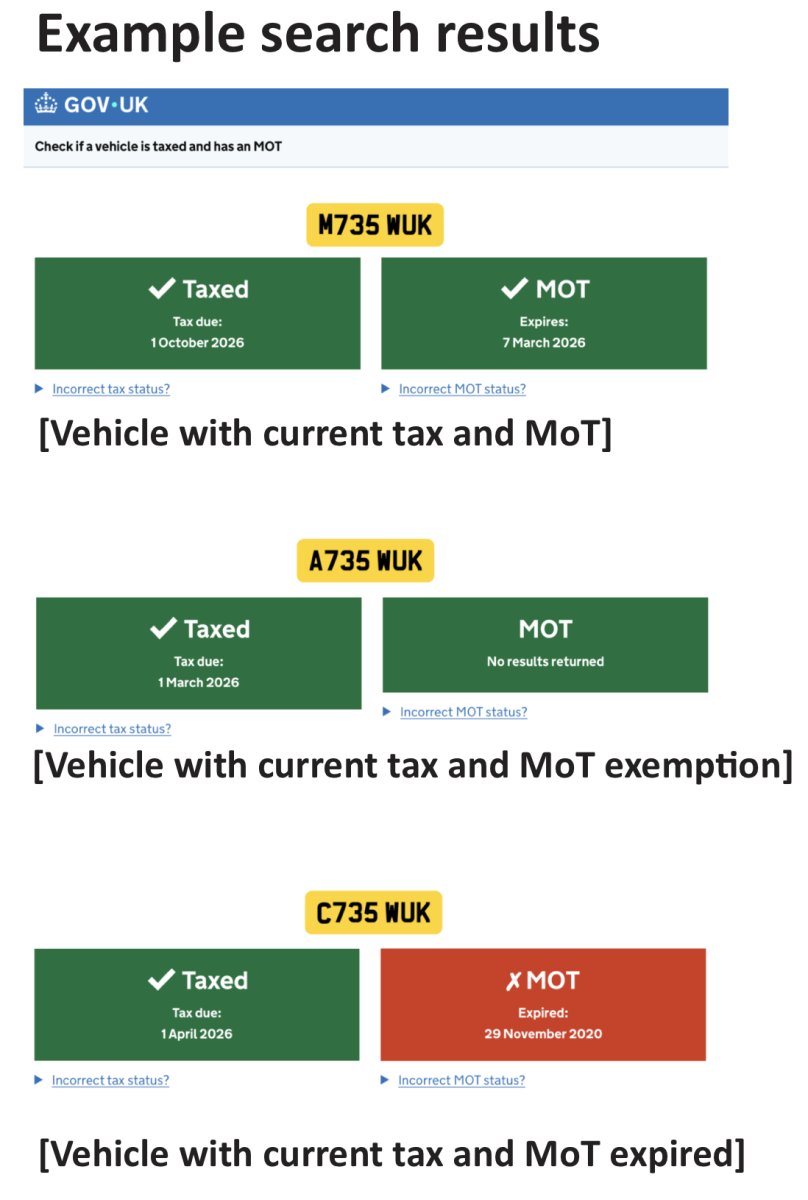
Notes
A vehicle which has just attained 40 years age, whilst being test exempt, will need to continue to pay vehicle excise duty in the 'private light goods' or other relevant tax class until April of the following year. This vehicle may have a SORN declared towards the end of March (which would trigger a refund) in order to then be re-licensed in early April in the historic class at a post office as outlined above.
Lorries are only test exempt if they are pre-1960, a date restriction which also applies to buses used commercially, again in both cases subject to the 'not substantially changed' criteria.
Finally, please note that some vehicles are exempt from both tax and test, certain vehicles are exempt from test, others are exempt from tax, and some vehicles are not exempt from either. For more details about tax classes see the leaflet V355/1
IMPORTANT WARNINGS: Regardless, any vehicle that travels on the public highway must be roadworthy at all times.
All vehicles in the Historic Tax class MUST be insured for use on the road, unless they are on a SORN. If the insurance then lapses, you will be committing an offence and be liable to an automatic fine and prosecution. To avoid this, if your vehicle is not insured, it must be declared with a SORN (Statutory Off Road Notice) https://sorn.service.gov.uk/
Declaring a vehicle that is in the Historic Vehicle tax class on SORN, will not change its status, or affect it when you come to put it back on the road (by taxing it at the £nil rate).
Is it possible to change the date of manufacture on my V5C ?
Yes, it is possible to change the ‘date of manufacture’ on your DVLA vehicle record, but it’s a slightly convoluted process and requires some work on your part. The process generally works as below for ‘normal’ volume/mass-produced vehicles. Others may be more challenging to do.
Note: You may find it easier (and cheaper) to wait another year and then apply for Historic Vehicle status. The choice is yours and this information below must not be treated as guidance or advice (as per our disclaimer at the top of this page).
If you can prove the manufacturing date, DVLA will change your V5C, but ONLY if you supply a ‘build date letter’ from the manufacturer of your motorcycle, car or van. This letter must be addressed to you personally and contain the vehicle’s details.
A ‘build sheet’, ‘birth certificate’, extract from other records, or similar is not normally acceptable. You may find it difficult to obtain such a letter from some manufacturers, in which case contact the relevant club for guidance (hopefully, you’re already a member, if you’re running a classic!)
To get a build date letter you will need to contact the manufacturer, normally via their Head Office. This covers all extant manufacturers from Ford to Harley Davidson. If the manufacturer is no longer in business, it may be that an archive or vehicle club can help.
Once you’ve got your build date letter, send the original (but keep a copy) to DVLA along with your V5C, and a covering letter explaining that you want the date of manufacture changed.
If DVLA accepts your request, it will send you a fresh, updated V5C. You can then take it to a Post Office to re-register it as Historic Vehicle in the usual way (see above).
Some manufacturers make a charge for build date letters (or for newer vehicles, typically after 1996 from when it was gradually phased in) Certificate of Conformity duplicates.
Generally you will need to supply the manufacturer with:
• Your vehicle's Registration Number.
• The 17-character VIN (Vehicle Identification Number).
• Proof of your vehicle ownership (V5C logbook)
• Pictures of the vehicle including the VIN plate and cold chassis stamping
Contact details of manufacturers are below. This is the latest information we have (tell us about changes or additions here), and is given in good faith. You are responsible for ensuring that any service you pay for will produce documents acceptable to DVLA. FBHVC cannot accept any responsibility if you pay for a service and the documents are not accepted by DVLA.
Ford (no charge): https://www.ford.co.uk/support/how-tos/owner-resources/vehicle-documents/how-to-get-a-build-date-letter
Peugeot, Citroën, DS (c. £60-220): https://laventure-association.com/attestations-documents/
Fiat, Jeep, Alfa Romeo, Lancia, Dodge, RAM, Abarth, Chrysler, Opel and Vauxhall (c. £210) https://homolog.stellantis.com/en
Jaguar Land Rover (fee unknown): [email protected]
Simca, Talbot, Matra (c. £75-£150): https://www.caapy.net/services/#identification/
BMW (c. £150): https://www.bmwgroup-classic.com/en/services/digital-birth-certificate.html
Mercedes-Benz (fee unknown): https://homologation.mercedes-benz.com/
Audi, VW (fee unknown): [email protected]
List of Club specialists who can help with vehicle registrations
In conjunction with the DVLA, the Federation keeps a list of specialist clubs who can help with the registration of vehicles, such as those imported from overseas, requiring registration in the UK and dating letters. The VHI List can be downloaded from the link below.
Further details of specialist clubs can also be found here: https://www.fbhvc.co.uk/member-clubs
The DVLA also maintains a list of clubs that it recognises to carry out inspections and produce reports to enable owners to recover registrations (registering a vehicle under its original registration number) where the vehicle is no longer held on central records due to being off the road for a very long time, and before the current SORN system was introduced. This is known as the V765 process. The DVLA provides a guidance and a list of vehicle owners clubs (in the booklet V765/1) which can be found here: https://www.gov.uk/government/publications/application-to-register-a-vehicle-under-its-original-registration-number
Page last updated: 24 September 2026
Downloads
| +VHI List v12 16.03.2026.pdf | |
| MoT DfT letter official.pdf |